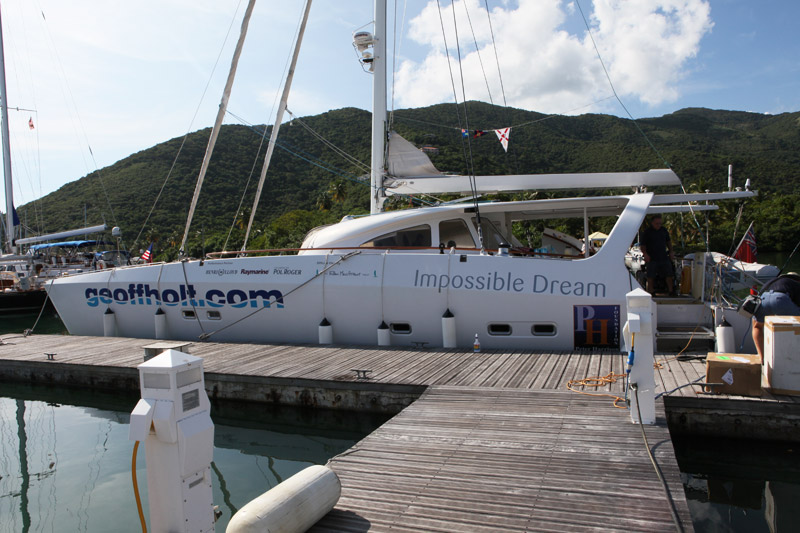
 Impossible Dream on the dock at Nanny Cay after her 28-day crossing
Impossible Dream a 60-foot catamaran custom-built to be sailed solo by someone in a wheelchair is now on the dock at Nanny Cay for repairs after a 28-day Atlantic crossing with Geoff Holt at the helm. Geoff, 42, completed the 2,700-mile voyage last Thursday, January 7th after setting off from Lanzarote in the Canary Islands on December 10, 2009. With this achievement, Geoff has become the first quadriplegic to sail solo across the Atlantic.
Goeff’s historic voyage has been extensively covered in the UK including a live broadcast on BBC News when he arrived at Cane Garden Bay and in major newspapers.
The Daily Telegraph reported: “Poignantly, he returned to the exact scene of the diving accident that paralysed him 26 years ago – Cane Garden Bay, on Tortola island.
“The arrival has been everything I expected and more,” Holt said.
“The welcoming committee has been amazing, I am surrounded by a flotilla of boats and yachts that have all come out to meet me. It’s emotional and I have a tear in my eye.”
This is the fourth time Holt has sailed the Atlantic, but the first time since the accident in 1984.
Geoff’s Bio
;) Geoff Holt catching up on 1,000 emails after arriving in Tortola (click to enlarge).By the age of 18, Geoff had sailed in excess of 30,000 miles at sea, including three trans-Atlantic crossings and several solo voyages. His career was cut short in 1984 by a life changing accident which left him paralysed from the chest down. Diving into shallow water broke his neck causing a complete spinal cord injury and he has used a wheelchair ever since.
Geoff Holt catching up on 1,000 emails after arriving in Tortola (click to enlarge).By the age of 18, Geoff had sailed in excess of 30,000 miles at sea, including three trans-Atlantic crossings and several solo voyages. His career was cut short in 1984 by a life changing accident which left him paralysed from the chest down. Diving into shallow water broke his neck causing a complete spinal cord injury and he has used a wheelchair ever since.
He has remained passionate about sailing and keen to support any initiative which provides sailing opportunities to other disabled people. In 1995, Geoff was a founding Trustee of the national disabled sailing charity RYA Sailability and now, through a network of more than 150 Sailability clubs and groups, more than 20,000 disabled people a year experience the freedom of sailing in the UK.
For more than 15 years he headed up regional marketing teams for two of the world’s largest firms of accountants. He holds a degree in Fine Art Valuation and has sat on just about every sailing committee representing disabled sailing both nationally and internationally.
More than 20 years after his accident, Geoff became the first disabled person to sail single-handed around Great Britain in an expedition he called Personal Everest.
“Sailing has given me so much in my life. It was my livelihood before my accident and it was to be my saviour after it. The freedom I experience on the sea is like no other; I am free of my wheelchair and free of my disability. When I am on the water, it makes me feel alive and any sailor, regardless of their ability, will know exactly that same feeling. Sailing is my life.” says Geoff.
On his return from Personal Everest, Geoff published his autobiography Walking on Water to critical acclaim.
Personal Atlantic was his latest adventure and raised funds for The Ellen MacArthur Trust.
For more information: Geoff Holt
Impossible Dream – the yacht
Impossible Dream’s owner Mike Brown, a T12 paraplegic himself, is now on Tortola and preparing the yacht for some Caribbean cruising.
Impossible Dream was launched in 2005 and is used by Mike’s charity ‘Sporting Activities for the Disabled’ formed to inspire people with disabilities to achieve some of their sporting goals. Over the years the charity has embarked on many projects but the main function of the work has been the provision of specialised equipment for skiing and sailing. In addition to Impossible Dream, the charity owns a small fleet of single-handed keelboats (International 2.4mR class) which it lends out to Sailability centres in the south of England.
The charity also owns a pool of skiing equipment (ski-bobs) which it rents to suitable applicants together with the skis and outriggers. This means that after learning the basics of the sport with trained instructors, people are free to go off to the snow with friends or family.
Impossible Dream is an all-carbon-fibre, fast cruising yacht was designed by Nic Bailey to be an easily handled, fast, comfortable and responsive yacht for wheelchair users to sail. It was an underlying requirement that all aspects of sailing, sail handling, docking, anchoring and maintenance should be capable of being carried out solo.
Mike has been an active adventure sportsman all his life. He discovered sailing following a bad skiing accident some years ago, since when he has raced 2.4 m keelboats, being well placed in the Sydney Paralympics. He also sails a small trimaran and was well aware that the key to building a fast cruising multihull is a combination of high power to weight ratio and easily driven hulls. It was an early decision to build the boat in all carbon-foam sandwich, not only for the direct reduction in shell weight but to set the philosophical yardstick against which all subsequent design decisions would be made.
The primary concept of the boat is defined by the ‘racetrack’ which runs around the perimeter of the bridgedeckhouse. It rises gently towards the bow, and is protected by a hollow bulwark that also provides stowage for fenders. At the aft end, the bulwark widens out to provide an outside helm position from which all sail trimming, engine controls and navigation functions can be carried out. The sail trimming from these positions applies to the mainsail and twin headsails, all of which can be tweaked by using hydraulic rams. Sheets are lead through the coachroof to bridgedeck level where they go to hydraulic self-tailing winches. These are coupled with hydraulic headsail furling gear and hydraulic in-boom furling for the mainsail; the hydraulics systems do add considerable weight to the boat, but this is the hardware that enables the boat to carry a racing size rig area, and more importantly enable Mike to trim the sails, and thus really drive the boat, on his own.
A lot of the time, the boat is handled from inside the bridgedeckhouse. There is a forward steering position, in front of the mast and behind a curved, laminated, toughened, solar reflecting glass, heated windscreen. The wheelchair locks onto a small chassis mounted on traveller track, which enables it to traverse the width of the cockpit giving the helmsman good access to all instruments as well as both primary winches, but preventing completely uncontrolled movement of the chair in bad weather.
The bridgedeck area and the outside ‘raceway’ are effectively a single unobstructed level with no steps or door thresholds. An internal lift in each hull enables full wheelchair access to the accommodation and heads. Two cabins are primarily designed for wheelchair access only and two cabins have full standing headroom, but are also accessible by wheelchair.
Impossible Dream has pivoting centerboards. Although these boards and the associated casings and hydraulics are perhaps not as efficient as daggerboards, it was concluded that to automate a sliding daggerboard reliably would pose far more difficult technical problems; whereas a pivoting mechanism gives the added benefit of a safety release in the event of striking an underwater object.
The wheelchair lift mechanisms utilise standard track and traveller car components driven by a small hydraulic reel winch, and most of the custom components have also been used in the two external lifts that give access to the dockside. Each of the external lift platforms lies behind a hinged hull panels that can rotate into a horizontal position once the five way locking dogs have been manually released from the dockside. Because docking conditions can vary, the boat is also equipped with a two-part passerelle that stows flush with the aft deck and can be manouevred into position by use of travelling hoists fitted into the undersides of the aft davits. Part of the passerelle also doubles as a bathing platform.
The systems are run by a generator and battery banks with backup electrical supplied by an alternator on the starboard engine.
For more information:
Sporting Activities for the Disabled charitable Trust aka Impossible Dream